

Have you been applying through job portals for a very long time now?
Uploading the same résumé or writing slightly different cover letters, while waiting for a reply, can be tiring.
And you’re not alone.
For many Bangsamoro applicants today, waiting has become an unspoken part of their day. However, some of us are on their phones while waiting, ranting about the backer issue in BARMM.
Seeing people get hired so easily because they have MBA or May Backer Ako frusrate many Bangsamoros.
Your frustration about the backer issue actually has a formal name. It’s called nepotism.
It is the practice of favoring individuals based on their relationships and connections rather than their skills and qualifications. In fact, it goes against the principle of merit and fitness enshrined in the Philippine Constitution and is regulated under civil service rules.
However, some of us don’t just bash the process, they bash the entire system.
Here are the things we sometimes forget to consider:
Not everyone who gets hired is a product of nepotism. In Moro communities, families and social networks are naturally close. Kumbaga pa, halos lahat naman tayo mahkakamag-anak. Being connected doesn’t automatically mean someone was hired unfairly. Sometimes, people are both qualified and connected.
Nepotism doesn’t exist only in BARMM. It exists throughout the Philippines. and even in countries frequently praised for meritocracy. The United States, for example, has long struggled with political dynasties and insider advantage.
Government vacancies are limited. Every opening attracts hundreds, sometimes thousands, of applicants. In data gathered by the Development Academy of Bangsamoro in 2020, there were 2,146 applicants per 7 job posts in no eligibility-required jobs. Even highly qualified people don’t get hired because there are not enough need for personnel, hence the limited slots.
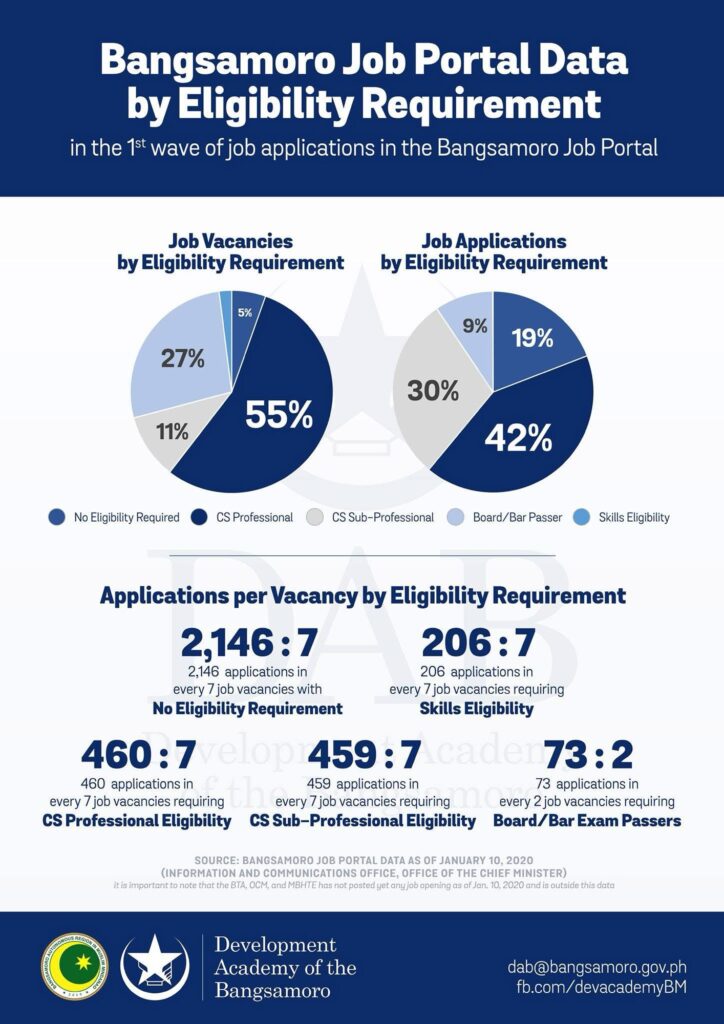
Knowing this doesn’t make the experience less painful, or right. However, it can remind us that what we’re facing isn’t personal. It’s structural, and it’s old.
BARMM Hiring Process is Actually Improving
Despite the noise, there’s evidence that the BARMM hiring process is improving.
Many now openly share stories of getting hired without a backer. Some received feedback within a week. Others waited years.
Nevertheless, the truth never changed: Life is not fair.
Economists have a name for this imbalance, the Pareto Principle or the 80/20 rule.
How this principle explains the unfair design of life
Economists call this imbalance the Pareto Principle, or the 80/20 rule where a small portion of inputs often produces the majority of results.
Pareto observed that roughly 20% of people control 80% of the wealth.
This pattern repeats everywhere, 20% of workers produce 80% of results, 20% of creators get 80% of attention and only 20% of students receive 80% of opportunities.
To put it simply, the Pareto Principle expalains that a small number of people often receive most of the rewards, money, attention, opportunities, while the majority receive much less. This happens not because the others lack effort or worth, but because small advantages grow and multiply over time.
Life follows patterns of accumulation, not fairness. Once someone gets ahead, even slightly, the system tends to give them more. Meanwhile, many who work just as hard remain unseen.
So life isn’t unfair out of cruelty but it’s unfair by design. Without conscious effort to balance things, inequality becomes the natural outcome.
If you only have 20% of time or energy that only you can do to better the quality of your life, might as well invest it in the only thing you can control: yourself.
Here’s What You Can Do About It
You don’t need to do everything, just focus on the vital 20%. Choose arenas where small effort yields large leverage.
Learn new skills – Go beyond your degree. Learn marketable skills like business writing, graphic design, and public speaking. This will make you more adaptable and useful in any workplace.
Be more qualified – Strengthen your résumé or PDS by earning units, diploma courses, or TESDA certifications. This signals discipline, commitment and shows that you are willing to learn.
Gain more experience – Seek learning opportunities even if they don’t meet your expected compensation. Do internships, volunteer work, or enter project-based roles. This will help you gain confidence and competence in real world more in ways theories won’t.
Investment in yourself may not guarantee that you’ll be accepted on job portals. However, it will guarantee that wherever you go, you have something to bring to the table. And gaining real-life experiences will surely build your character that will make you stay if you want to stay.
You are your biggest investment, you might as well be so good they can’t ignore you.