
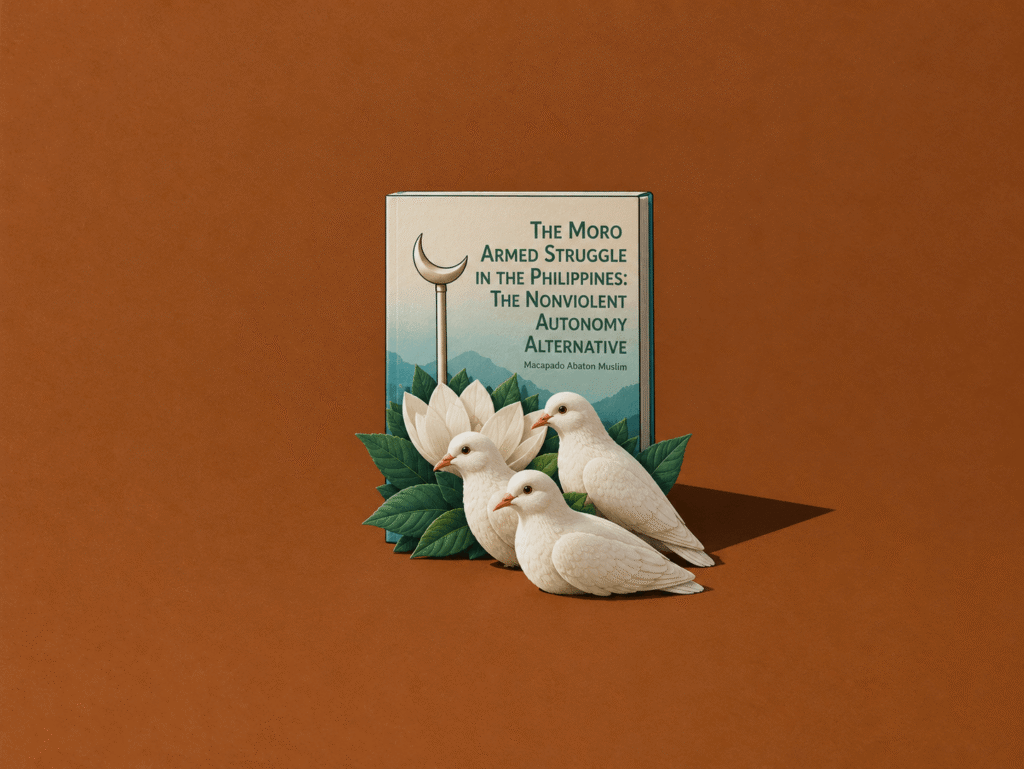
I wasn’t really a fan of Bangsamoro history books. Not that I found them boring or unimportant, but as an ordinary Moro who didn’t come from a political clan, I thought it was a waste of time to read about injustices and wrongdoings that we had no power to change without risking our lives.
Until one afternoon in 2022, after I put my one-year-old baby to sleep, I picked up the book that had been sitting on my shelf for months.
It’s a book entitled Moro Armed Struggle: The Nonviolent Autonomy Alternative, written by former Mindanao State University President Dr. Macapado A. Muslim. He was also the MSU President when I was in college at Mindanao State University–Main Campus, so that only made me more curious about the book.
It was his PhD dissertation at the University of Hawaii in 1990, but he published it as a book in 1994. Then, when Rodrigo Duterte became President, he reprinted it in 2017 to shed light on the recent Marawi Siege, reiterating that war doesn’t happen out of thin air.
So he believed the book could help former President Duterte’s efforts to resolve the Bangsamoro problem. The Government then should address it by curing its root cause rather than its mere symptoms. Dr. Macapado then claims that the only way to end the Mindanao conflict was to reconsider their “misplaced peace-making approach” and give the Moros genuine autonomy. Because, aside from its unjust history, the archipelagic nature of the Philippines also made autonomy more sensible.
Packed with fairly researched stories, the book aptly captures the history of the Moro Land before, during, and after Martial Law, all in 145 pages written like a typical history book, informing
The book informs the readers who are unfamiliar with the contemporary Moro armed struggle, and would like to keep up, all in 145 pages.
Packed with in-depth stories, the book aptly captures the history of the Moro Land before, during, and after the Martial Law, which is, indubitably, the peak of oppression and atrocities to the Moros.
Unlike the usual history books about violence, you’ll read less about the men behind bombs and tanks and more about the ordinary people living ordinary lives dolefully disrupted by Martial Law. This includes a series of painful events in Moro history such as the Jabidah or Corregidor Massacre, the Ilaga atrocities, the Manili massacre, and others.
One thing I took away from the book was the author’s argument that the Moros didn’t initiate the war, despite how cruelly they were portrayed in the media. For a decade, they pleaded with the Marcos regime to stop the killings. It was only when the regime showed no intention of stopping them that our ancestors felt compelled to defend their land and their lives.
As the book progresses, you’ll also see that it was not a war of religion, either. Christians were not viewed as enemies. In fact, the leaders among our ancestors referred to them as “friends” in their manifestos and promised to protect them. The Moro fighters only highlighted their religion i.e. Islam seeks support from other Muslim countries, and not necessarily their driving force.
Of the book’s seven chapters, the third was the only one I found tedious. The author presented statistics about how rich Mindanao was before Martial Law and how it eventually became the Philippines’ milking cow. Still, I’m glad I pushed myself to finish it because it helped me understand just how much our natural resources had been exploited.
I recommend this book to every young Bangsamoro who, like me, wants to understand where our struggle comes from but doesn’t know where to start.
It’s not a book you should read in one sitting because, since it was originally a dissertation, it’s too detailed. I read one chapter a day to fully digest the meat of each.