
Imagine This
You lived in a house built on land your parents inherited from their parents.
You could have built your home anywhere, but that land mattered. Beyond the rice fields your family had tended for generations, it was where your childhood revolved.
Then one day, a total stranger arrived.
They told you they now owned your four-hectare land because the government gave it to them.
You went to court. The judge sided with the stranger. They had a piece of paper proving ownership, even though everyone knew you had lived there your entire life.
You couldn’t ask your tribal leader for help. He, too, was fighting for his own land against another stranger holding another piece of paper.
Fighting felt pointless.
So you packed your bags. Before walking uphill with your family, leaving everything behind. You looked back at the land where you once played, climbed, and ran as a child.
This was the story of many Moros before you and I were born, during the long and painful phenomenon called settlement.
This post is a simple, accessible guide to understanding the history of the Mindanao land conflict—how it began, who it affected, and why its consequences are still felt today.
Who are the “native people” in Mindanao?
If a group of people share the same ancestors, customs, traditions, and believe in the same values, they are called a tribe.
If they have their own language that they only speak, making them even more unique to other people, they are called an ethnolinguistic tribe.
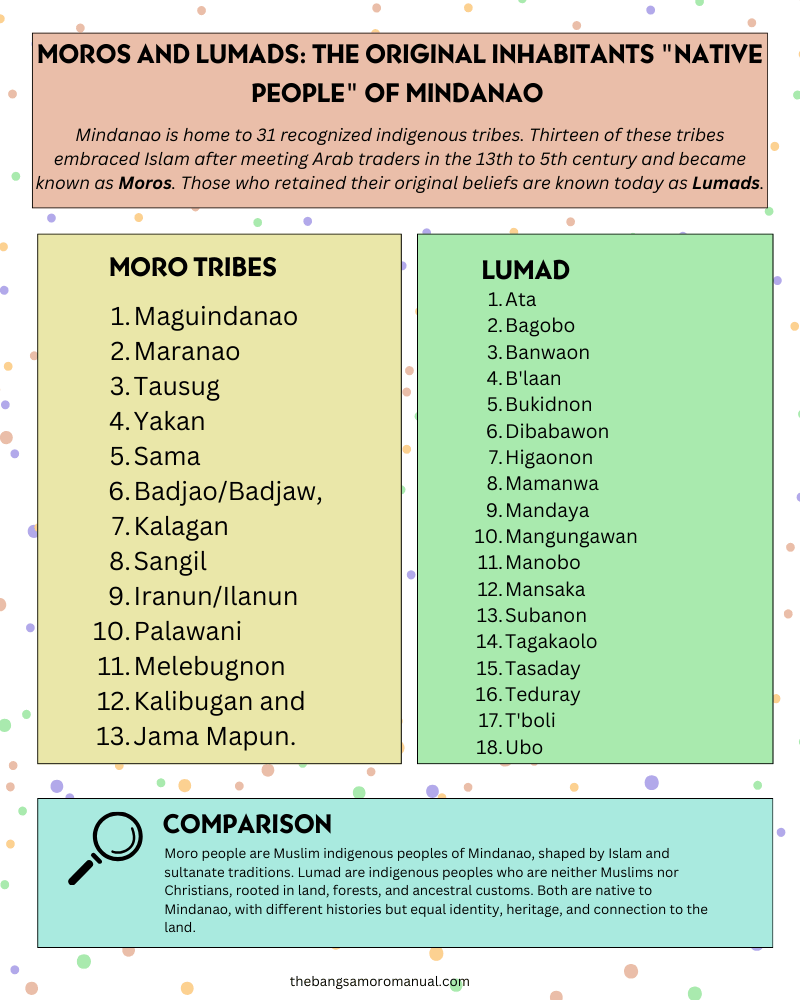
There were 31 ethnolinguistic tribes considered to be natives or original inhabitants of Mindanao.
However, between the 13th and 15th centuries, 13 groups among them embraced Islam.
They heard the message of Islam from Arab missionaries and Muslim traders. They liked the message and voluntarily accepted it.
Later, those who embraced Islam became known as the Moro people or Bangsamoro, while those who did not became known as Lumads.
Read: History
The conflict started during American rule. When they saw Mindanao, they saw a future.
Mindanao: The Land Of Promise
In the early 20th century, Mindanao became popularly known as “The Land of Promise” because of its fertile lands and vast forests. If developed, the government can surely make money out of it.
This could be a good thing, romantic even, if only developing Mindanao also benefited the native people of Mindanao. But it did not.
Why the Americans Settled Mindanao
American settlement policies were driven by three main motives:
Political control over Mindanao
Access to natural resources
Economic profit from agriculture
But despite all these, did you know that the early Moros wanted to be under the rule of Americans rather than the Filipinos?
Here are some of the reasons why:
During the time of the Americans, only the wealthy could migrate to Mindanao because the land registration was costly and the transportation fees to Mindanao was expensive.
But during the commonwealth, even the ordinary Filipino migrated in large numbers because they were given free transportation and free land or sold lands for a very low price with free farming tools.
Before the commonwealth, the Americans still recognized the Moro leaders’ authority. So they only let a limited number of settlers in limited areas they can reach through trains or vehicles.
But under the Philippine Commonwealth government, they migrated a larger number of settlers and they even gave them forested areas.
Here’s how it actually started.
How Settlement Started
There were small settlements during Spanish times. But under the Americans, settlement was formalized, legalized, and systematized. When Filipinos later governed Mindanao, they expanded it further.
Americans brought democracy to the Philippines. Democracy has a legal system. It’s like a rulebook of the country about what’s right and wrong.
They set up courts and trained their judges about American laws that should be applied to the whole country.
Later in 1912, Americans made a turning point. It introduced a land ownership system unknown to, and disregarded Moros’ system.
Moros way
Unlike the Americans, natives of Mindanao, Lumads and Moros, didn’t know that a land could be your “private property” like we practice today.
For them, lands, rivers, marshes and lakes and all other natural resources are gifts of God that anyone can use to survive, not a property that you can own.
They have usufruct rights (not absolute ownership) to lands passed down by their ancestors also known as pusaka. It’s determined by lineage, not individual ownership.
Communal land:
Sultanate laws on land:
They pass onto their kids the lands [research].
However, when Americans came in the early 1900s, they turned lands into private properties. Their rule was simple: if you have documents that the land is yours, it’s yours. Otherwise, it’s not.
This system is called the Torrens System.
In the Torrens System, you must first own land and register it with the government, which then issues a Land Title. Then the government will put you on the Registry of Deeds. This is something new for the Moros and Lumads.
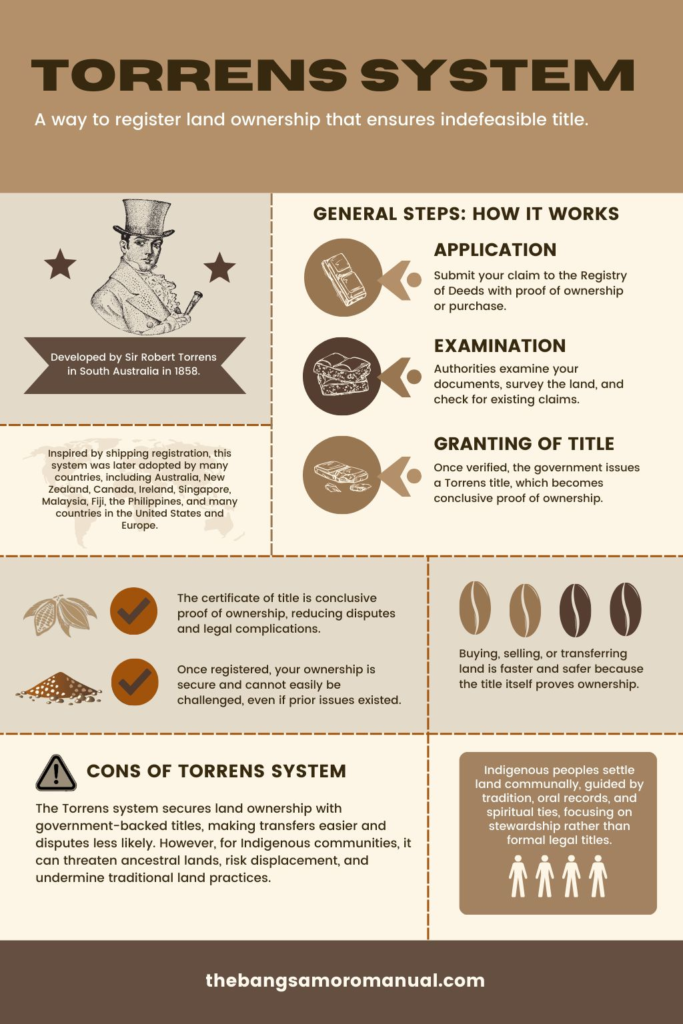
This system is entirely new to the Moros because for centuries, they settled land ownership and boundaries through adat, oral agreements, and mutual trust.
Here are the laws and policies that started everything:
1902: Land Registration Act
In 1902, the US issued a law that required all landowners to register their land. This law is called the Land Registration Act of 1902, issued through the US Philippine Commission.
Unlike Christian Filipinos in Luzon and Visayas, most Moros did not possess land titles, not because they lacked land, but because they were never fully conquered by Spain and had no exposure to Spanish land documentation systems.
The Moros sought help from American officials on how to register their lands but they were largely ignored.
Some historians suggest language barriers played a role. While others argue that Americans simply favored Christians.
Regardless, this system disregarded the Moro’s rights.
1903: Public Land Act
In 1903, just a year after the Land Registration Act, the American-led government issued another law that treated all unregistered lands as “vacant” and now declared as public lands. This is the Public Land Act of 1903.
In this law, the government can lease, purchase or homestead. Homestead means letting other people own the land if they live and farm on it.
However, only foreign corporations occupied Mindanao at this time.
The “free land” didn’t really attract people to migrate to Mindanao because they had to travel to Mindanao thru calesa, trambia and bancas. And riding those was really expensive at that time so only the wealthy ones could afford to migrate.
(List corporations)
But even so, many of them returned to their hometowns because of malaria and being away from their relatives made them feel isolated.
So the US Government improvised.
They opened seven agricultural colonies.
1913-1917: Agricultural Colonies
The government took a group of people and move them to different places in Mindanao. They told them that if they farm crops and make the land productive, they can finally own the land.
The areas where all these families farm together is called an “agricultural colony”.
These colonies were established in:
During those times, Americans and growing Filipino officials fought over who would settle in Mindanao: the American farmers or Filipinos from Luzon and Visayas?
Later, the latter have won. Filipinos from Luzon and Visayas were prioritized—to prevent Mindanao from separating from the Philippines.
But.
As mentioned earlier, despite all these, early Moros still prefer to be under American rule than the Filipinos. Because they expected their fellow Filipinos, their fellow colonized, would correct the injustice and restore their rights. But it didn’t. It, in fact, intensified the settlement.
The Filipino Officials under Philippine Commonwealth
To prepare the Philippines for independence, Americans created the Commonwealth of the Philippines in 1935.
In this type of government, the Filipinos governed themselves but still under the supervision of the Americans. So it’s basically like a practice government.
Except that, even if it’s seems like a practice, you still govern real people and your actions will leave real consequences to them.
And the actions of the commonwealth government really left problems that the Moros and the Philippines are still learning to reconcile.
Migration Under the Philippine Commonwealth
The Commonwealth intensified the homestead and moved more Christians to Mindanao and addressed instead the reasona why people did not migrate.
Road construction
They constructed roads to make transportation easy.
1936 – 1941, they constructed the road that links Davao to Cotabato. This made migrating easy.
Next is the road through the Koronadal valley then linked the Cotabato-Davao road to Pulangi river, opening Sayre highway that leads to Carmen Basin, Pulangi Valley then Bukidnon plateau.
The road construction continued until it reached Agusan to Surigao.
As for Davao Gulf, they linked it to Agusan valley and Butuan Bay.
Then they also connected Lanao del Norte to Zamboanga City, then Zamboanga del Norte.
Rural Health Units
The roads might attract migrations but they also feared the spread of Malaria in Mindanao at that time.
In response, the government created rural health units.
As more settlers came, small towns and municipalities grew.
How did the Settlement affected the Moros
The new roads and hospitals constructed in a once lushy land may seem like a successful nation-building if you read it in books.
But for the Moros and the Lumads, it was oppression and injustices .
Land grabbing
The free lands that government gave away was actually theirs. It’s where their families and their ancestors lived and farmed for centuries. Then out of a sudden, people came to their doorsteps claiming their lands without their consent or compensatioon.
Economical Marginalization
The main slogan of the government didn’t feel the “Philippines for Filipinos”. because back then, the Philippine government only took the Mindanao as part of the Philippines, but not its people. When corporations and schools stood in Mindanao, they still prefer hiring Christians over to Moros.
Social Displacement
The mass migration to Mindanao actually pushed the margins of their own land.
Moros to the edges.
The Culprit was the System Not the Settlers
These were before social media so people back then could only rely on what they heard from what’s within their reach.
Who wouldn’t want free or cheap hectares of land?
During these times, majority of the settlers didn’t intend to “grab” the lands of the Moros and Lumads.
These were people who also have been enslaved for centuries.
They were only ordinary people who had ordinary dreams. That is to build a new life for their families.
They’re farmers already from Luzon and Visayas so they really worked hard to build their lives by farming from sunrise to sunset.
They exchange tools and crops. Together, they formed a village of their own.
Moros, Lumads and Christians had learned to coexist, especially in towns and cities.
Disputes related to land conflict between settlers, Lumads and Moro groups still exist today. Some even resort to violence.
However, Moros, Lumads and Christians had learned to live side by side. They now share public spaces, markets, roads and workplaces.
Muslims in The Philippines Today
There are still numbers off and reports of discrimination among Muslims in the Philippines, Even in Mindanao places dominated by not Muslims.
However when BARMM was established, The Muslim minorities in the Philippines had been given a change put all themselves and to craft policies that fits their customs and beliefs.
Tri-people in BARMM today.
There is a report of land conflicts in this area some even begin violent. The reason why most reported in Kidapawan where xxx Muslims was murdered.
In BARMM, they are known as Tri-people: Lumads, Muslims, and Non-Muslims.
They had learned to coexist, especially in towns and cities.
However, Moros, Lumads and Christians had learned to live side by side. They now share public spaces, markets, roads and workplaces.
Tri-people in BARMM can practice their religion freely.