My preferences in books always change because I, too, am changing. Lately, as I’ve become more curious about my cultural identity, I have also been eager to explore Moro literature, fiction or nonfiction. I am fascinated by the diversity and richness of the Moro identity.
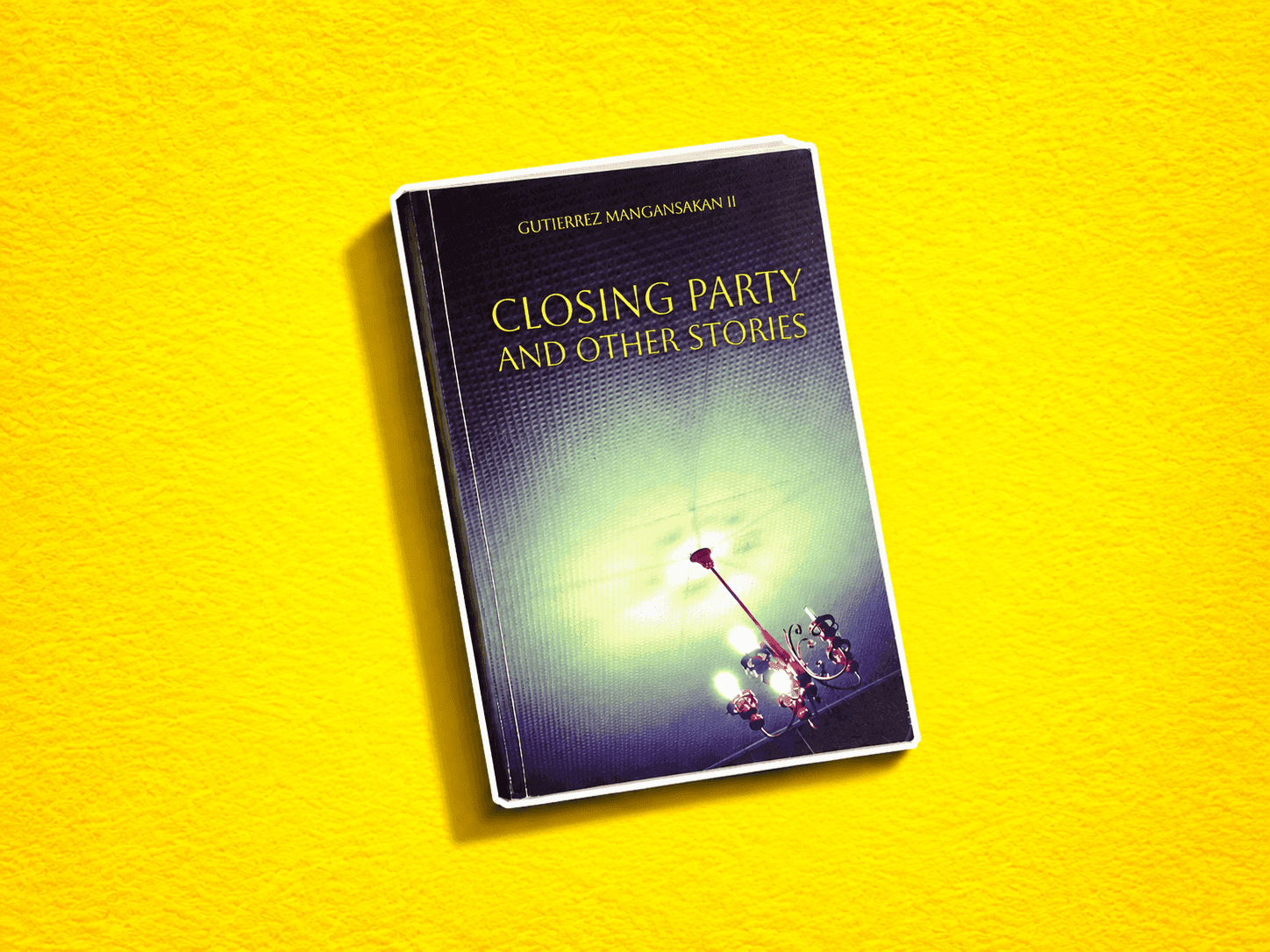
When I heard that the renowned Maguindanaon filmmaker Gutierrez “Teng” Mangansakan, whose writing I had read usiq once on his blog, had published a book, I immediately bought a copy. I slowly read this book alongside my other readings, Sapiens and Why We Sleep, and my household chores.
Closing Party and Other Stories is his debut collection of short fiction, which he wrote over fifteen years, in between his travels and filmmaking career. I believe his filmmaking background contributed a lot to his ability to construct and unfold scenes. Each story is so much more than a reflection of Moro identity, I encountered a writer in full command of his craft. I expected I’d only find what I already knew and perspectives I had already explored, but I was wrong. I learned a lot about the Maguindanao identity from this book
The Maguindanaon are one of the thirteen Moro groups that gradually embraced Islam since the 1500s. While some Maguindanaons continued pre-Islamic adat alongside Islam, others completely embraced their Islamic identity and abandoned old customs they considered un-Islamic.
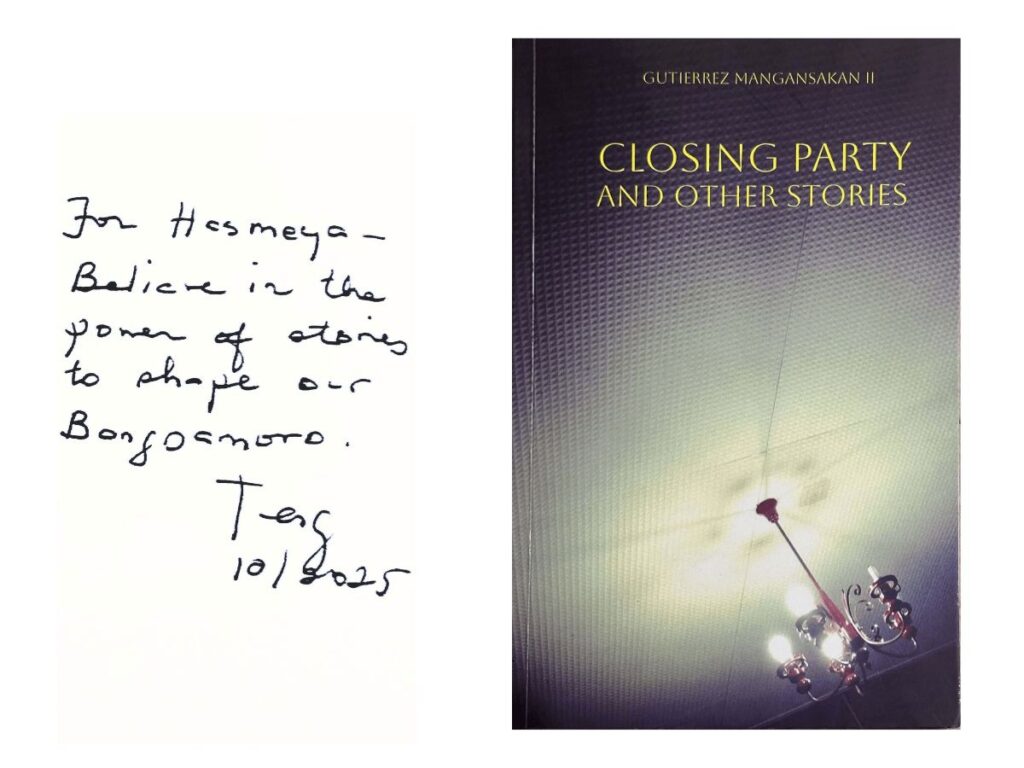
The book showed the diversity of the Maguindanaon group, especially the fine line between Maguindanaon cultural identity and Islamic religious identity. These two are different. And yet, Teng Mangansakan portrayed them well with compassion and understanding, instead of reducing them to stereotypes and caricatures.
In his story Turning the Sky, there’s a man who has the paranormal ability to stop the rain, along with his other abilities. Conservative Muslims often warn him not to meddle with forces that are not his to meddle with. When the man dies, his daughter is torn because she is gifted, too. But she often hears scientific explanations from her educated brother about things that people often interpret as supernatural. This resonated deeply with me because I also witnessed several phenomena in my childhood for which supernatural explanations were so popular that any scientific explanation would sound inadequate, no matter how logical.
Most of his stories about shamanism and other pre-Islamic practices are set in the upper valley, or laya. But Teng wrote them with such texture that even I, a tau-sa-ilud Maguindanaon, can still resonate with their universality. One work I am particularly drawn to is “Lifting the Veil.” In this story, three women sought a shaman because they didn’t know what to do. Before going there, the three of them met at another woman’s house.
While the four of them reflected on their shared longing for something powerful, one of them said, “But I have come to realize they are not magic,” referring to the potion. “They are only permission. People take them when they are ready to act but need something to blame. ‘It was the potion,’ they say, not ‘I made the choice … Perhaps deciding is the real sorcery.’” This illustrates women’s social conditioning of always asking for permission, as if their minds and bodies are not theirs to decide for themselves.
While I was reading this piece, I was also questioning a lot about womanhood, especially my preconceived notions about my autonomy as a woman. As I grow older, I have realized that women are taught that their worth lies in servitude. They are expected to carry the weight of the world while making it look effortless
Sometimes, this is instilled in them with supporting Islamic texts: that they should serve their families, that they need to be protected, and that if they get married, their service is transferred to their husbands. I personally believe these are all true. I am for marriage, and I am for gender roles. I recognize that each gender has strengths and weaknesses, and I personally believe that marriage is a divine way of complementing each other to build a family. However, when women are taught how to be “a good woman,” they are unknowingly conditioned to center men and other people, and often totally erase themselves from the picture.
This conditioning became clearer to me when I became a mother and bore the expectation that women should maintain a spotless home, regardless of what is piled on their plates. I have little kids, and I aim to raise them with little to no screen time. And the more I read books about trauma and development, along with my background in philosophy of education, the more convinced I’ve become that letting them make a mess is far better than interrupting their play all the time just to remind them of house rules that only matter to me and not to their development.
Over the years, I have also learned that how I show up for them is deeply tied to my relationship with myself. And so, while they make a mess, I write and read and elevate my education.
And yet, I have already encountered numerous remarks about our house being a mess and disorganized, or men mocking me for asking help from my husband.. And as I get used to it, the more I realize how culture can actively shape a woman if she’s not clear about her goals, her purpose, and who she’s living her life for.
I don’t think this imposition on women is Islamic; rather, I think it is cultural. Because I have lived for seven years in a Maranao community that is more Islamic than ours, and yet its women are not told to erase themselves from the picture.
I can still remember when it was my first time there. I was also a bit judgmental because my Maguindanaon culture was still fresh in my mind. I noticed that most Maranao households I saw seemed tolerant of domestic disorder. Whenever I saw one, I could already hear how a typical Maguindanaon woman would nag and stress over a similar mess and scoff at almost everyone while she put things back in order. Over the years, I realized that Maranao women are simply choosing their battles. They are businesswomen or ustadha with so many engagements.
They offer short courses in Qur’an memorization, fiqh, and other subjects they want to teach because, since they’re so conservative, women learners often prefer to learn only from women teachers. When you talk to them, their conversations are so rich because they have so many adventures beyond cleaning their houses all the time. So when they clean their houses, they do it because they want to, not because it is tied to their worth as human beings.
Some say that this burden on women of maintaining the house as their only priority has only been passed down from precolonial times, when slavery was still part of the Maguindanaon culture. Regardless of its roots, I still hold that a woman’s worth is not in her service but in who she already is. How well she treats herself will inevitably influence how well she treats others, too, and not the other way around.
I have three kids under three years old, and I only clean up after my kids’ mess before I sleep. I don’t follow them around to clean every mess they make. Our house is only disorganized, but it’s not dirty. I still make it a habit to deep-clean whenever I feel like it because, although we have help around the house, seeing I cleaned something by my own hands still gives me a different kind of relief and a sense of achievement.
Lifting the Veil was so poignant that I sometimes forget a man wrote it. My eyebrows naturally raise whenever a man talks about how Muslim women should live. However, Sir Teng knows more, has more experience, and has really captured this particular experience of Maguindanaon womanhood.
Culture can sometimes lead us to mistakenly think that the way we know how to live is the only best way to live. In his story A Woman of Her Own, an aristocrat unlearns and relearns about her own humanity and that of others after studying in Manila and leaving the place where she was worshipped. Because sometimes, seeing other people live differently can pop the bubble you were once caged in, and all this time, things you once held as an absolute truth are not the only valid way to live. Teng shows that encouraging people to embrace their identity doesn’t always mean romanticizing it.
And then there is the piece “Closing Parties,” where a young man endures subjugation by a Spaniard only because he feels special. It might seem like desperation at first, but I suppose this is the kind of work where we are supposed to hate Pablo or pity …, but mostly, it reads as passion and dedication to the craft … That there is still …
There is no doubt that Mangansakan is a brilliant, incisive storyteller. Nevertheless, when the book explored the difficult subject of female genital mutilation (FGM) in “The Crescent Moon in Daylight,” a practice called “Pag-Islam,” it would have been better if the story had drawn a clearer line between cultural practices and Islamic teachings. Despite its name, pag-Islam is not necessarily an Islamic requirement, nor is the practice widespread in Moro communities today. There is only so much one can say in a short story, but mixing culture and religion could probably misrepresent both. Given how precise and evocative he is in the rest of the collection, this essay falls a little bit short of the others. Still, the story stayed with me when the character said, “Bangsamoro struggle is only the start. The real struggle is in our bedrooms, in our kitchens, in our daughter’s names.”
RELATED: A Good Book You Can Start With